Passenger Mobility
Station-based regional travel supporting access to Lehigh River communities, D&L Trail users, workers, visitors, and local residents.
Infrastructure • Transportation • Development
Diggs Development Group Inc. advances visionary transportation, logistics, freight, emergency-support, and community development systems designed to move people, goods, and opportunity.
A multi-use regional transportation concept connecting passengers, medical logistics, consignment freight, emergency support, and local business stations.
Diggs Development Group Inc. Integrated Infrastructure & Regional Development
Adapt-a-Modal™ Transportation • Logistics • Healthcare • Emergency Response • Economic Development • Resilience
About DDG
Diggs Development Group Inc. focuses on infrastructure concepts that combine transportation access, business opportunity, public benefit, and long-term economic growth.
Our approach is practical and visionary: identify regional needs, design functional solutions, and align public-facing systems with private-sector development opportunities.
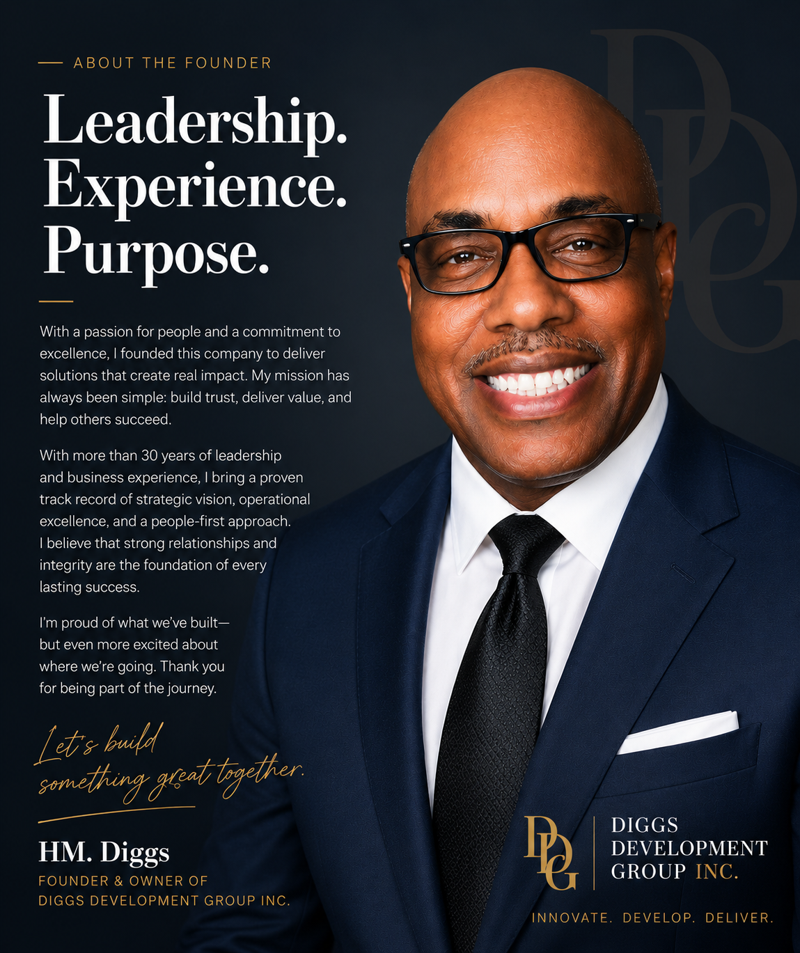
Meet the Owner & Founder
Decades of vision, experience, and purpose drive every project DDG takes on. Get to know the founder leading the way.
Flagship Concept
A flexible infrastructure platform supporting passengers, local businesses, freight logistics, medical access, emergency response, and specialized vehicle operations.
Station-based regional travel supporting access to Lehigh River communities, D&L Trail users, workers, visitors, and local residents.
Specialized spur routes can connect hospitals, warehouses, maintenance facilities, and consignment freight operations.
Law enforcement, fire prevention, hazmat, and water-treatment response vehicles can be integrated through Type A stations.
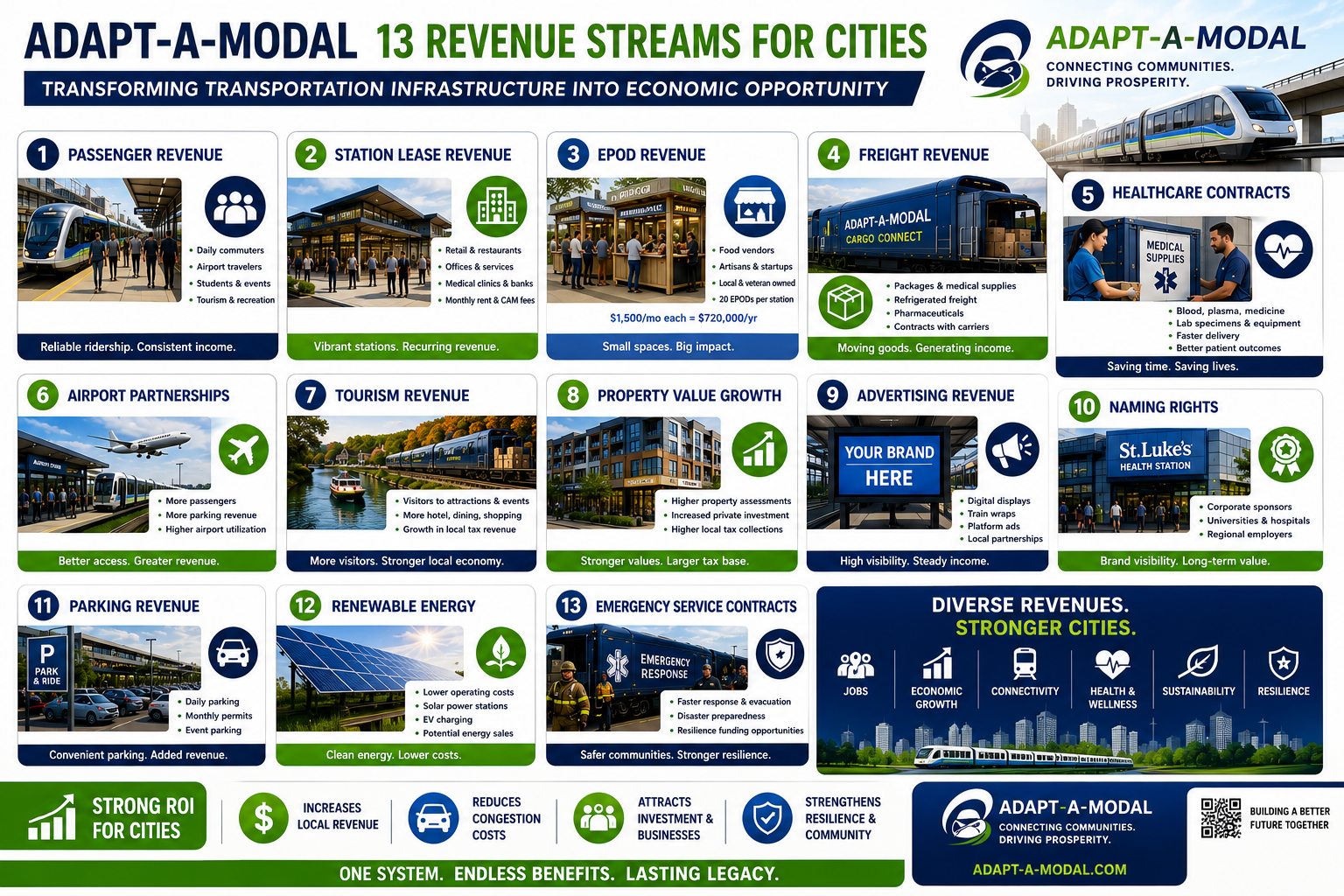
The network pairs mobility with leases, logistics, partnerships, energy, and public-service contracts—giving communities multiple paths to fund operations and grow local opportunity.
Modes of Transportation
Each unit rides the same elevated network, adapting the platform to a distinct mission — from passenger mobility and consignment freight to cold-chain medical cargo, mobile medical care, fire and hazmat response, mobile water treatment, and resource protection.
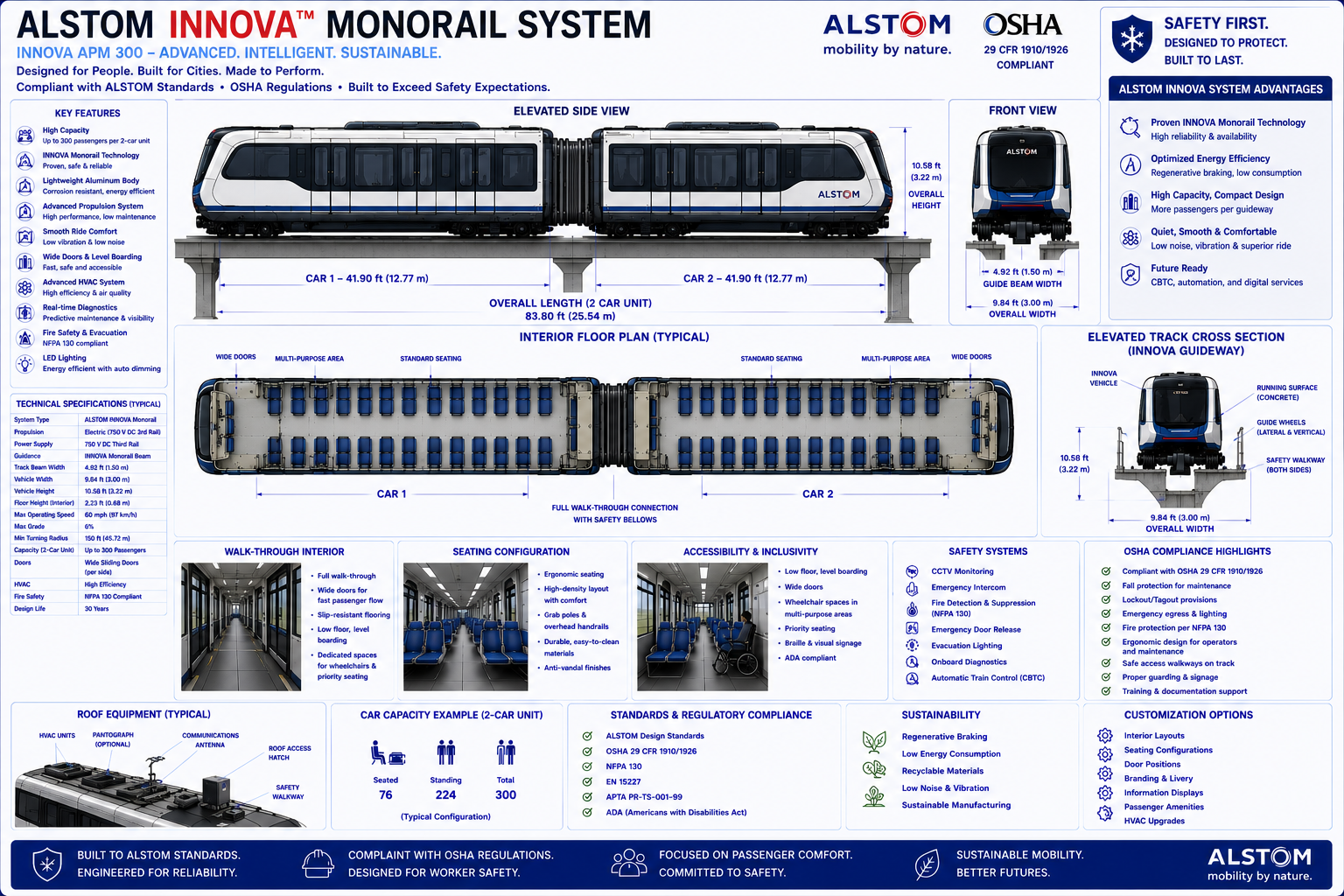 Passenger
The foundational two-car passenger platform every Adapt-a-Modal unit is built on, delivering high-capacity, accessible regional mobility across the elevated guideway.
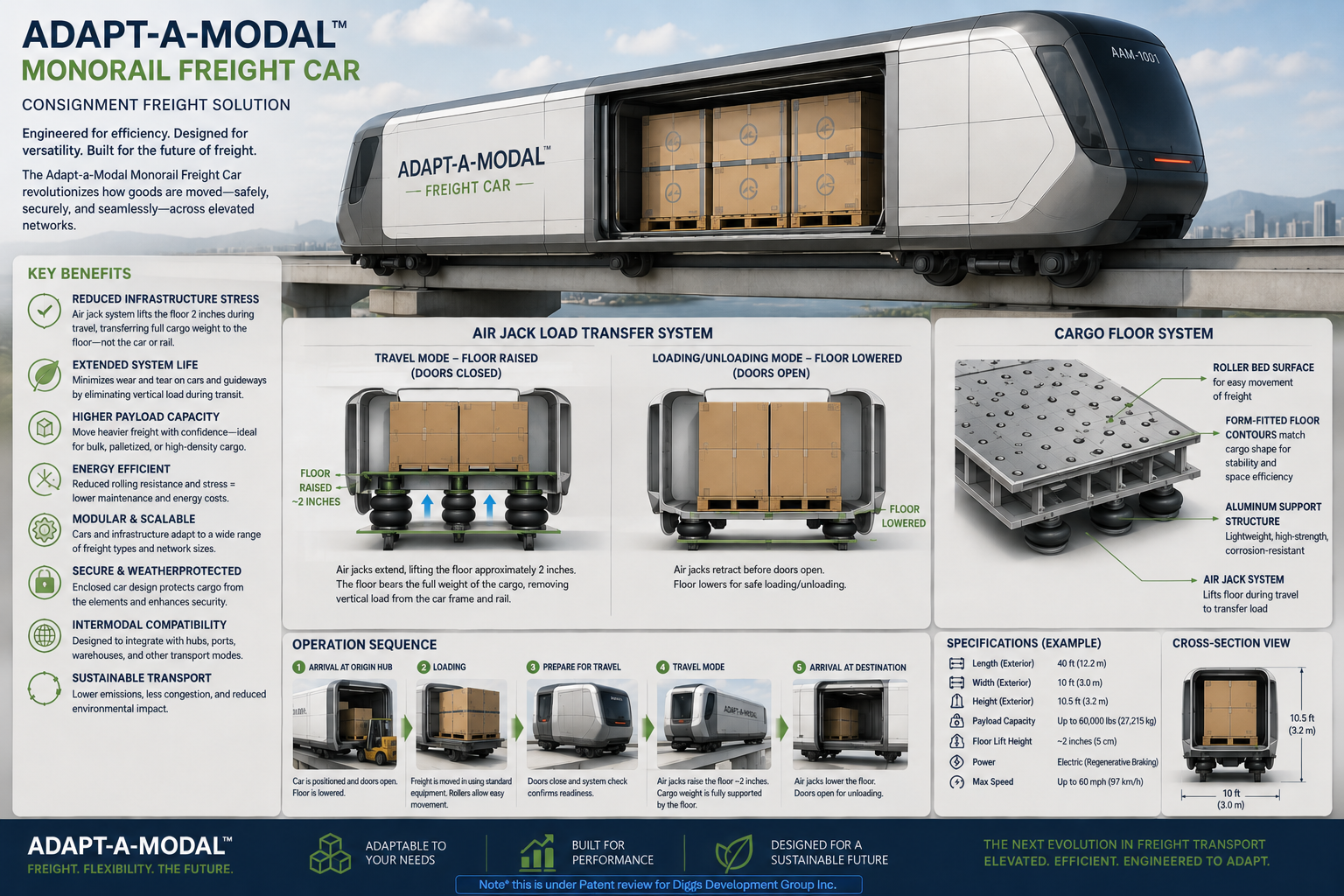 Freight
A consignment freight solution with an air-jack load transfer system and roller-bed cargo floor for safe, efficient loading across the elevated network.
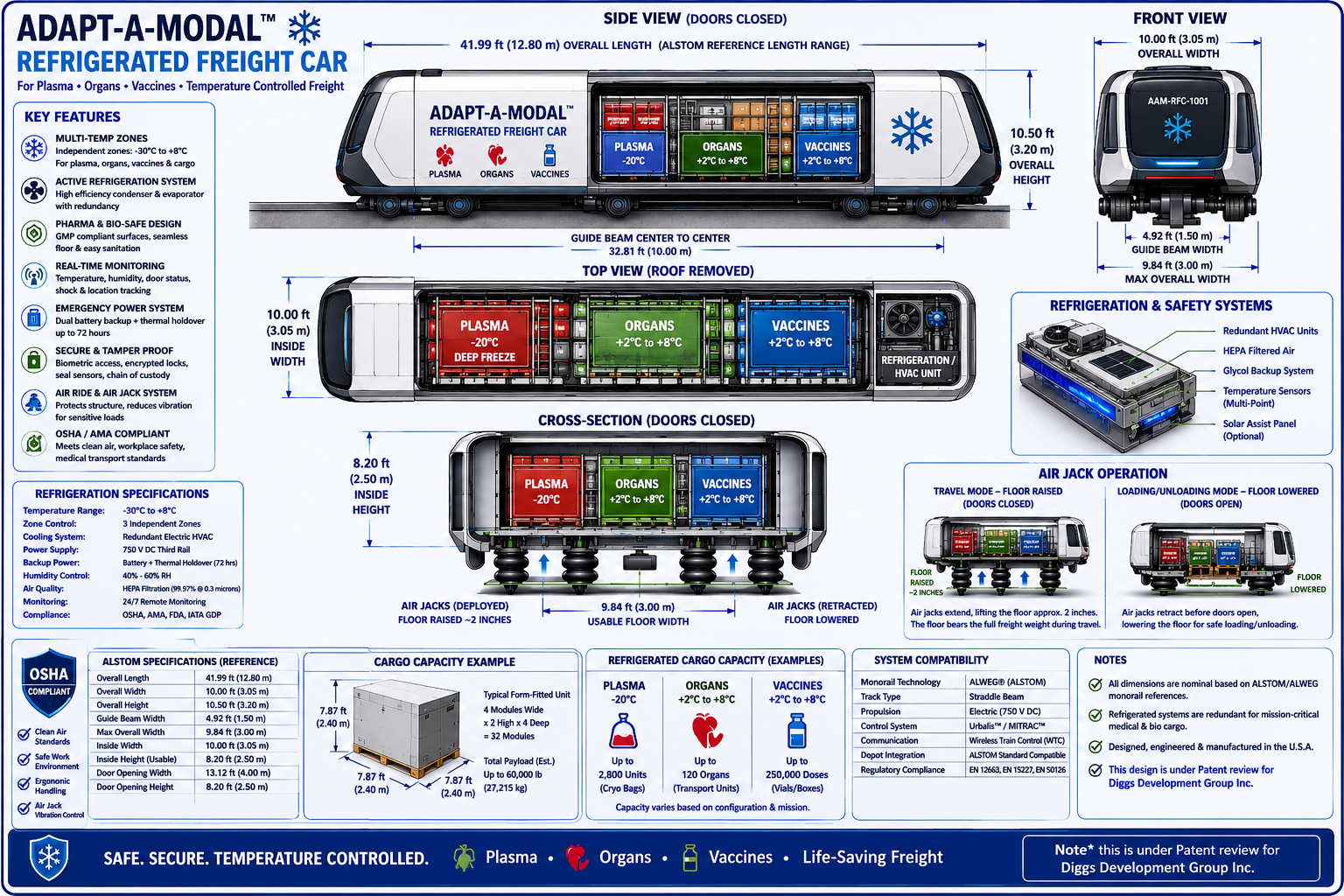 Cold Chain
A temperature-controlled monorail unit carrying plasma, organs, and vaccines in independent climate zones to move life-saving freight safely across the region.
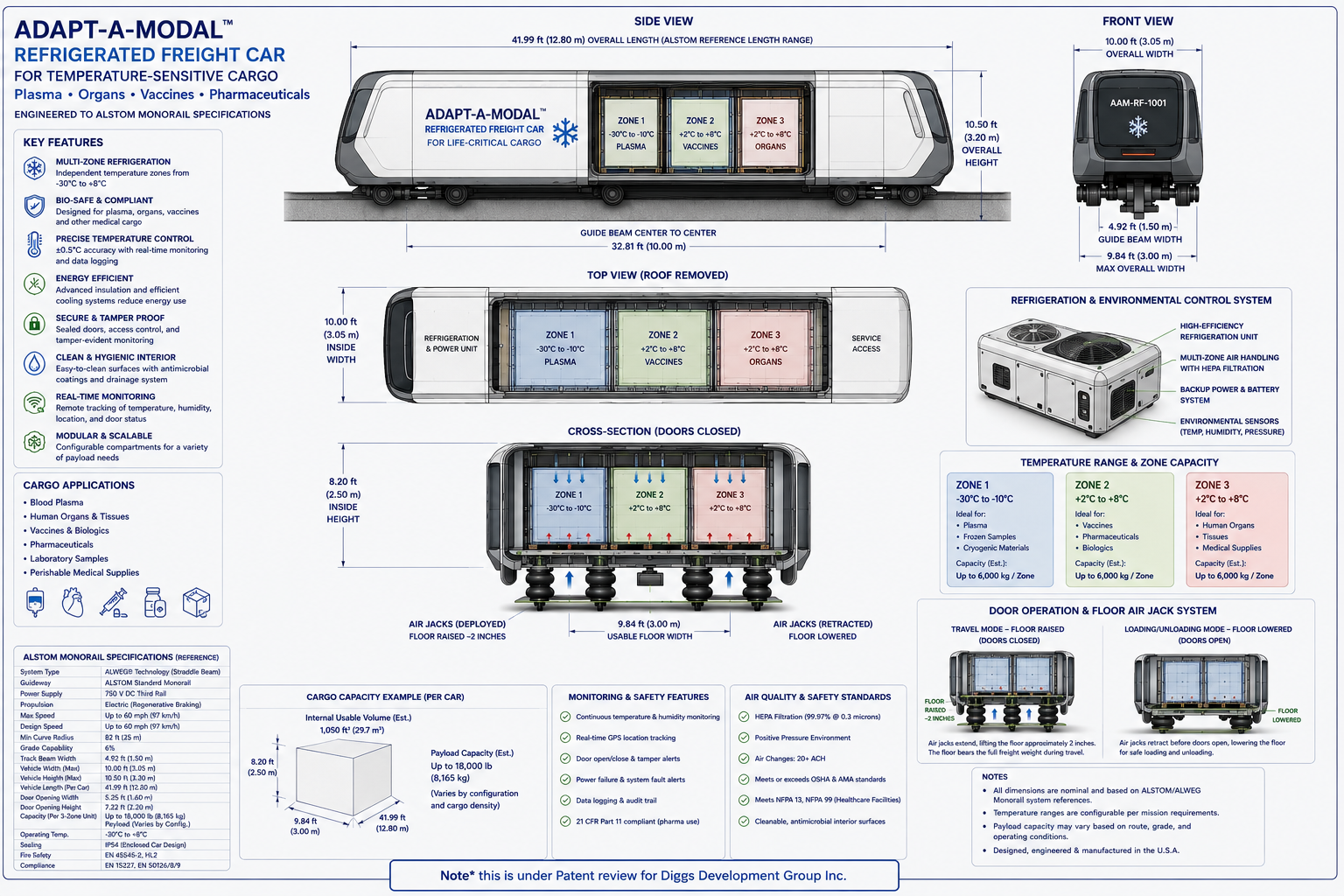 Pharma
A pharmaceutical configuration of the refrigerated car with three discrete temperature zones, engineered to ALSTOM monorail specifications for sensitive medical cargo.
 Medical
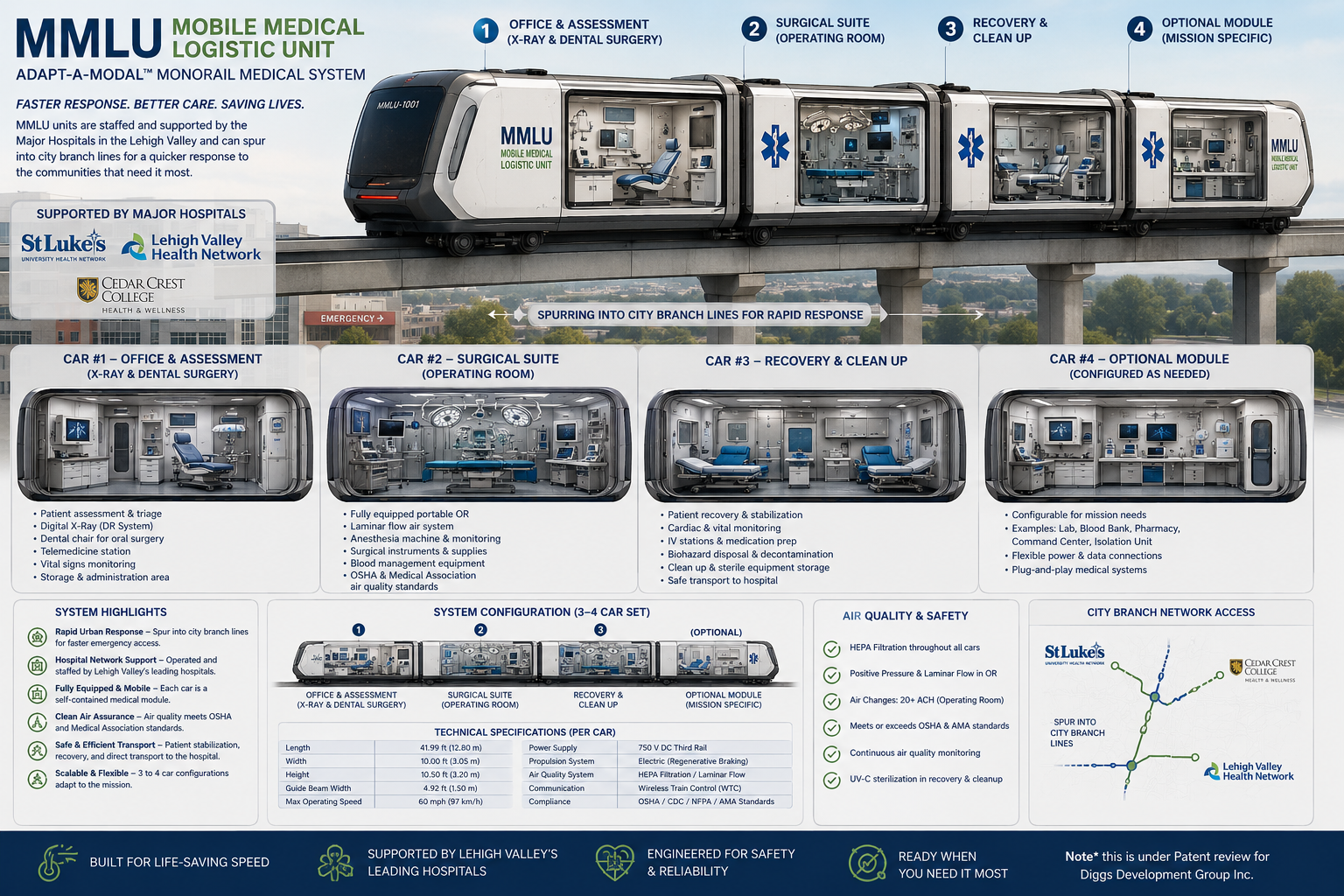
A monorail medical system that spurs into city branch lines for rapid response, configured as assessment, surgical, recovery, and mission-specific cars.
 Fire & Hazmat
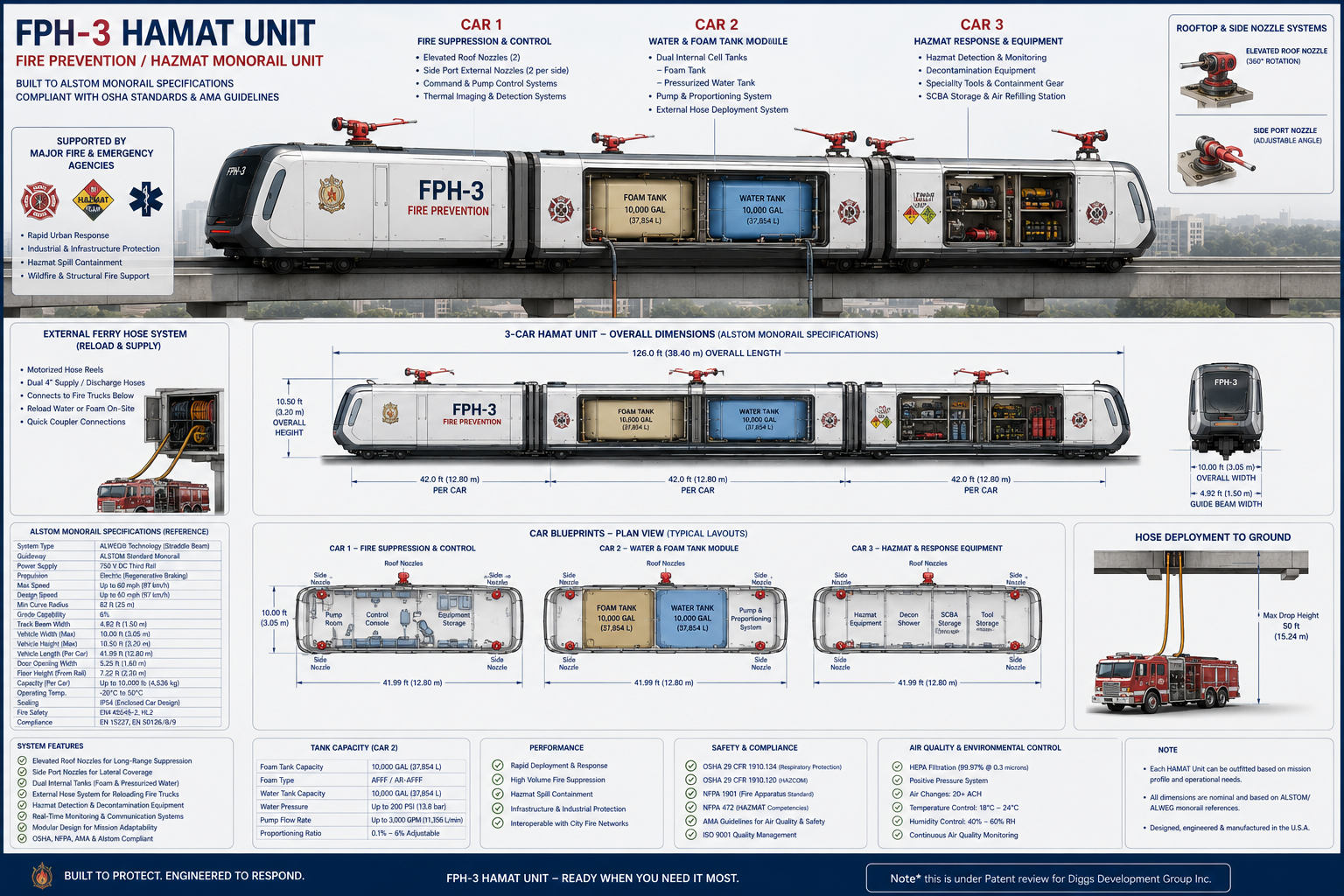
A three-car fire prevention and hazmat monorail combining suppression and control, an onboard water and foam tank, and hazmat response equipment.
 Water Treatment
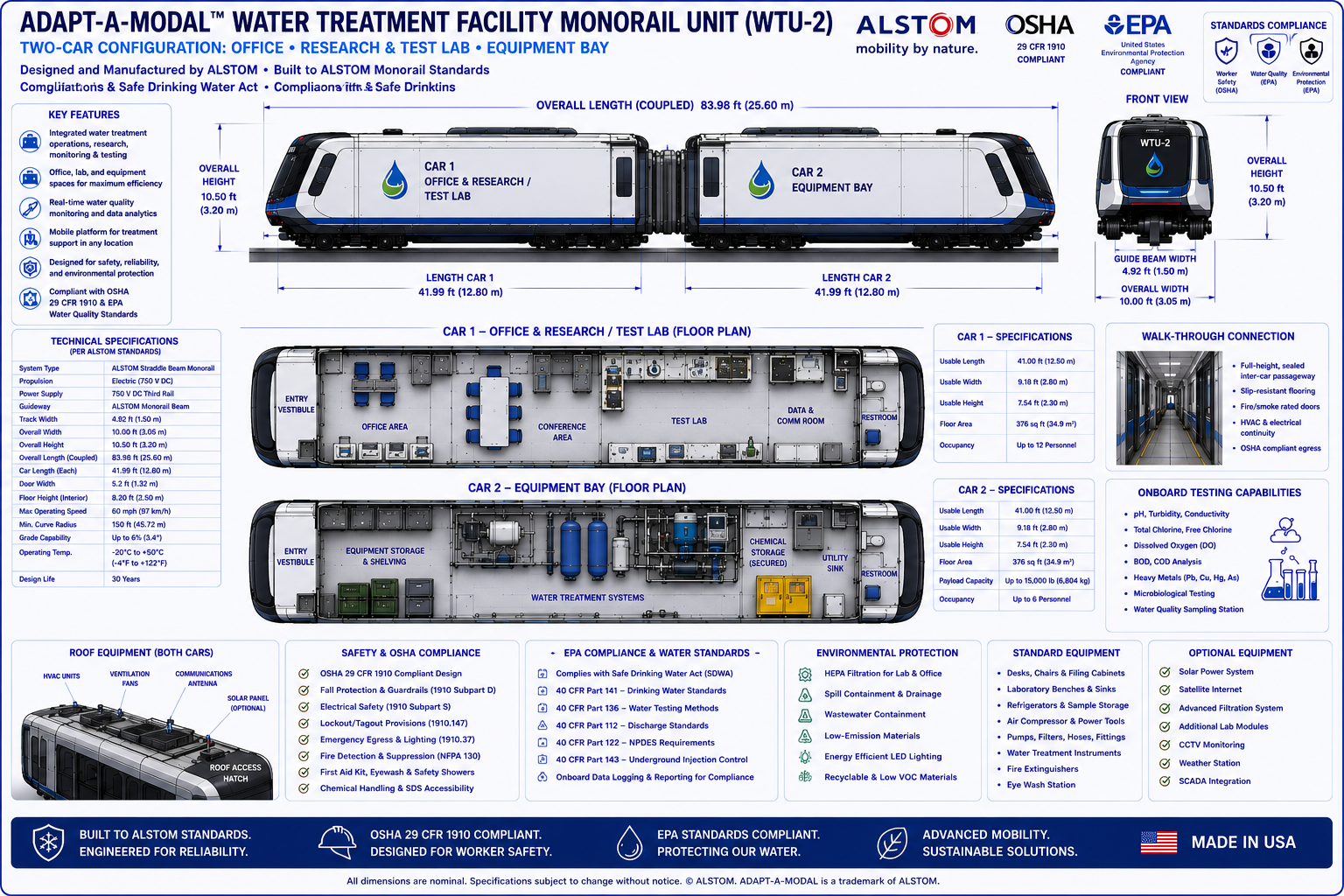
A two-car water treatment facility pairing an office and research test lab with an equipment bay to deliver safe drinking water where it is needed.
 Resource Protection
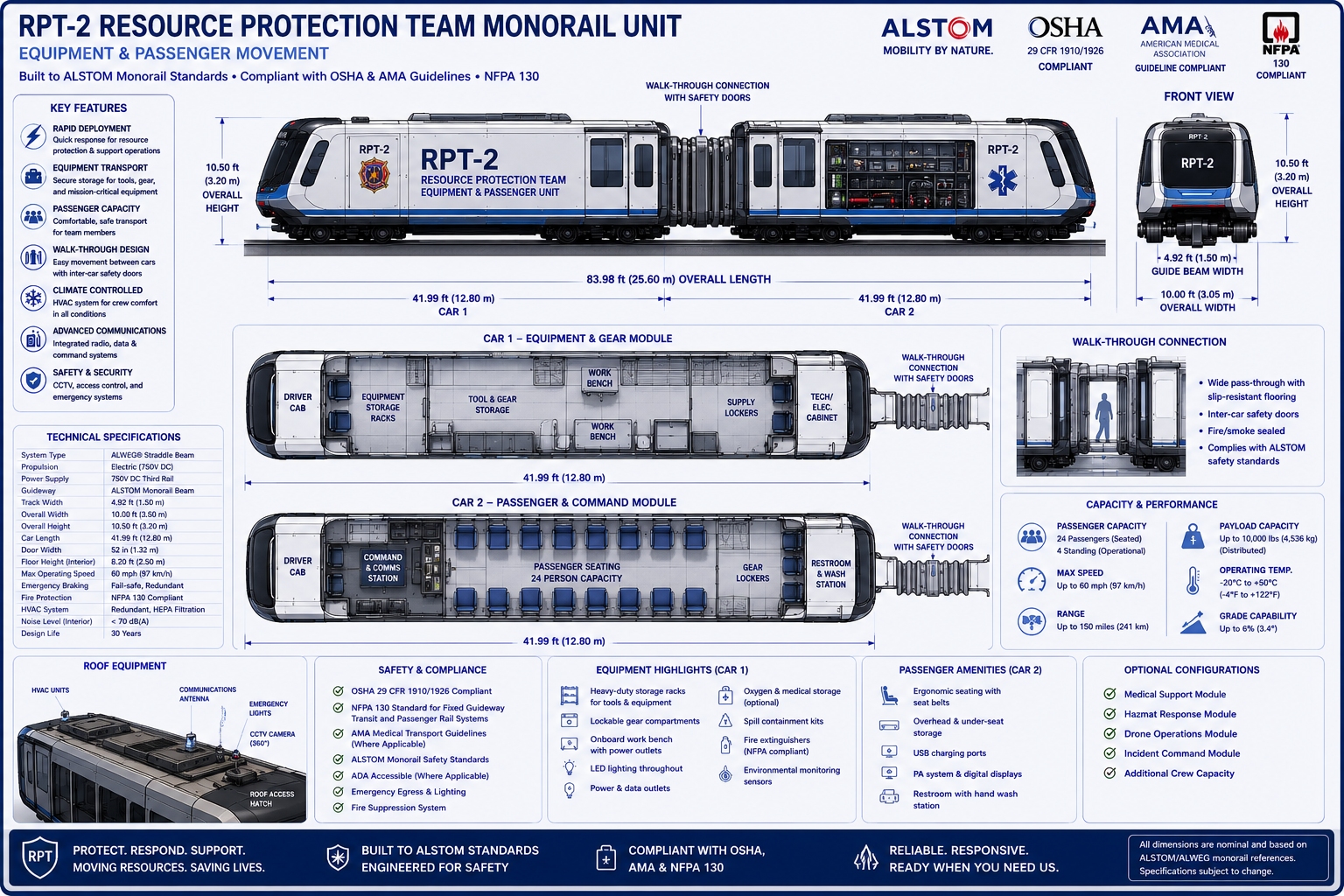
A two-car equipment and passenger module conceptually designed around applicable ALSTOM platform requirements and relevant OSHA/industry standards, subject to engineering validation. It moves protection teams and their gear rapidly to where they are needed most.
Interactive System View
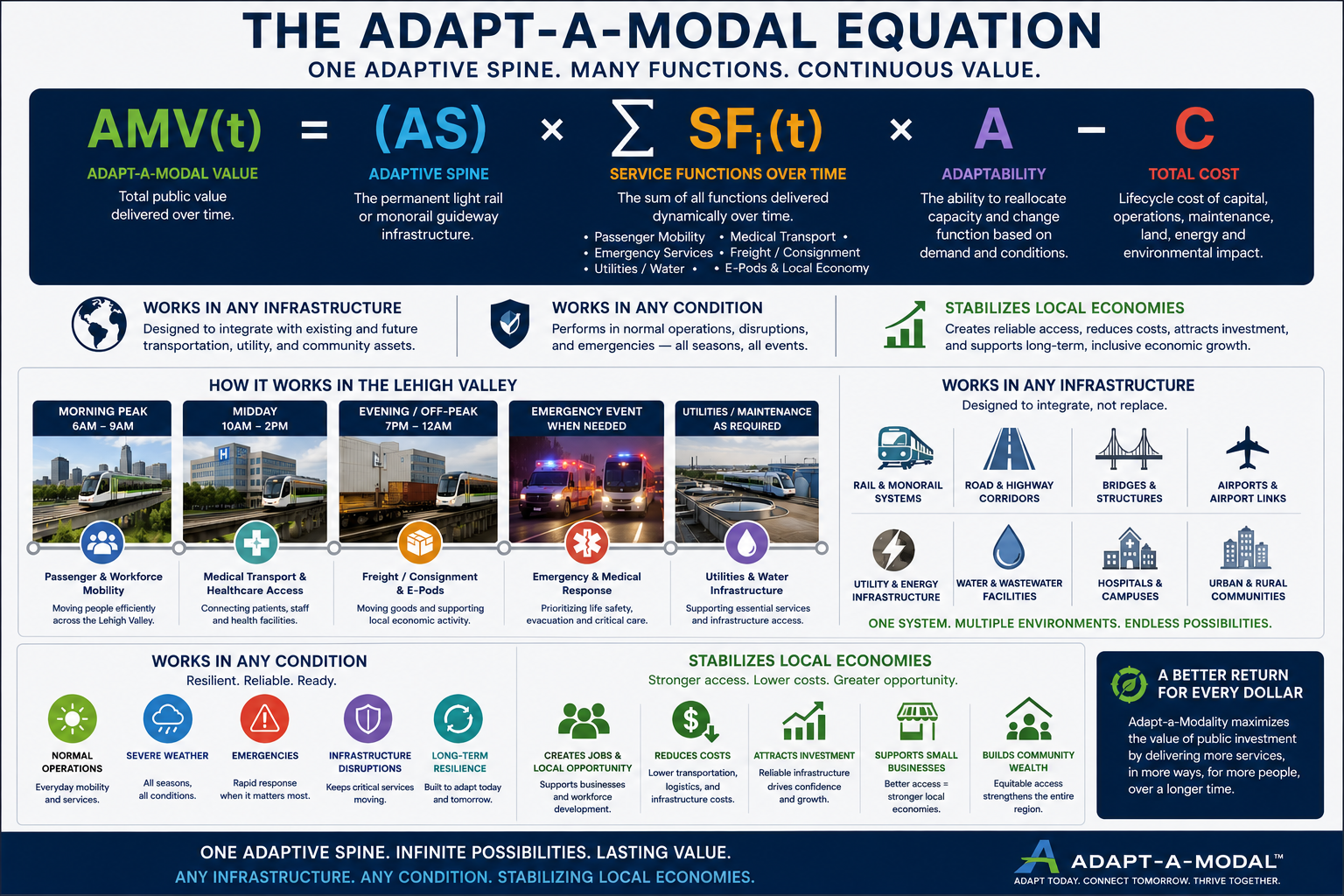
The left-side tab bar gives visitors a fast way to understand the Adapt-a-Modal model. Each selection opens a focused flow of information, moving from the core idea into the practical outcomes it supports.
The guideway can support daily passengers, freight movement, emergency response, and medical logistics without forcing every service into a separate route.
The corridor keeps ground-level recreation readable while adding regional access overhead.
Hospitals, airports, warehousing, treatment facilities, and town centers can plug into the same backbone.
Anchor stations can hold passenger platforms, retail, food service, emergency-support staging, and local business space.
Mid-scale stations can support boarding, parcel movement, vendor kiosks, and direct links back to the larger hubs.
Compact stops make trail access, park-and-ride use, ticketing, and local circulation easier to deploy.
Passenger units handle the public-facing mobility role, connecting work, recreation, healthcare, airports, and town centers.
Specialized cars can move consignment freight, pharmaceuticals, organs, vaccines, and other sensitive cargo.
Fire, hazmat, medical, water-treatment, and resource-protection units can operate from the same regional system.
The system frames mobility as part of a larger civic network, not just a ride from one stop to another.
Food, convenience, services, parcel pickup, and vendor space can turn stations into active neighborhood assets.
One permanent spine can shift between routine travel, freight needs, maintenance, severe weather, and emergency events.
Public Benefit & Function
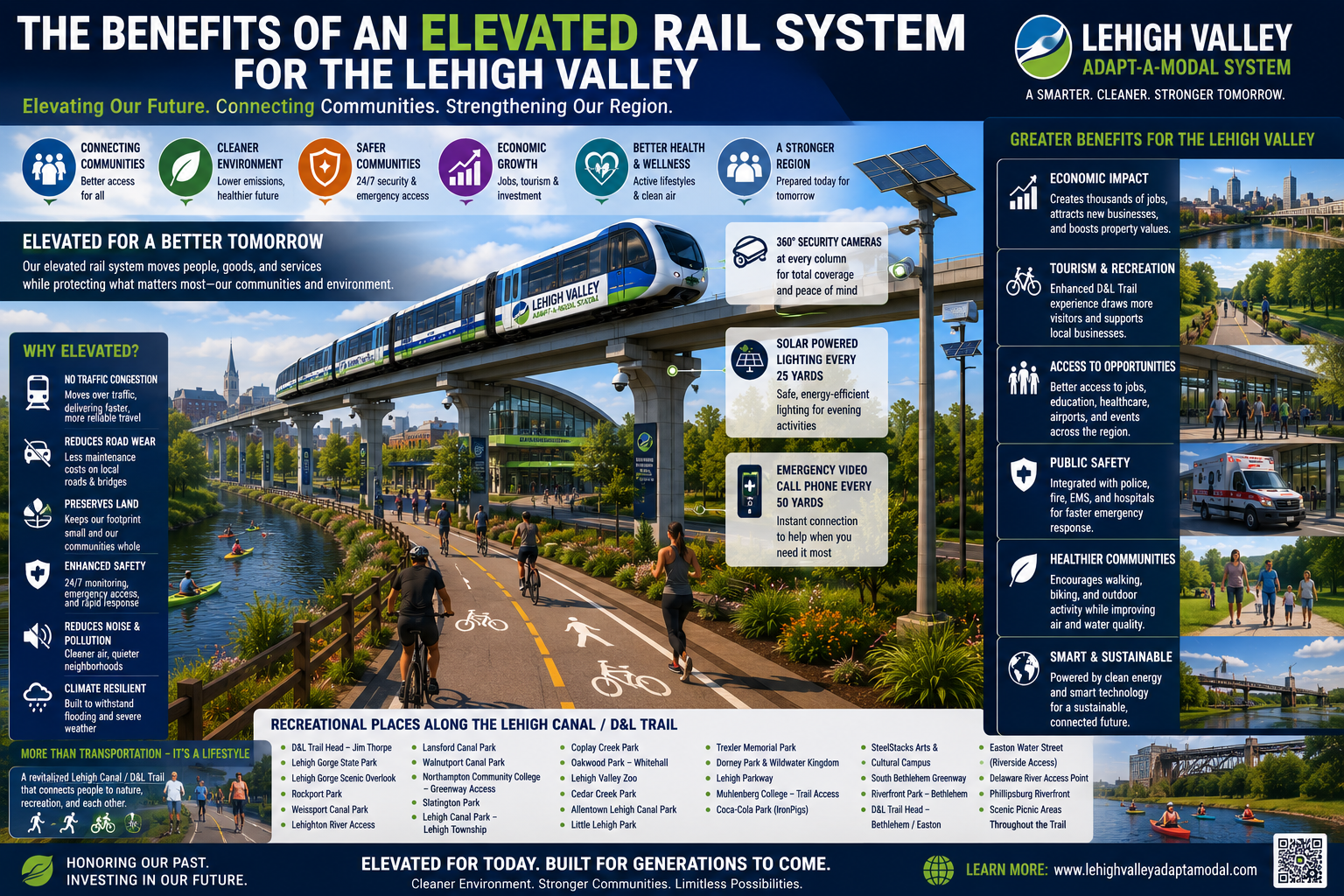
This piece fits as the public-facing case for Adapt-a-Modal: it explains how an elevated rail corridor can connect communities, protect the trail and canal environment, support safer access, and strengthen regional opportunity.
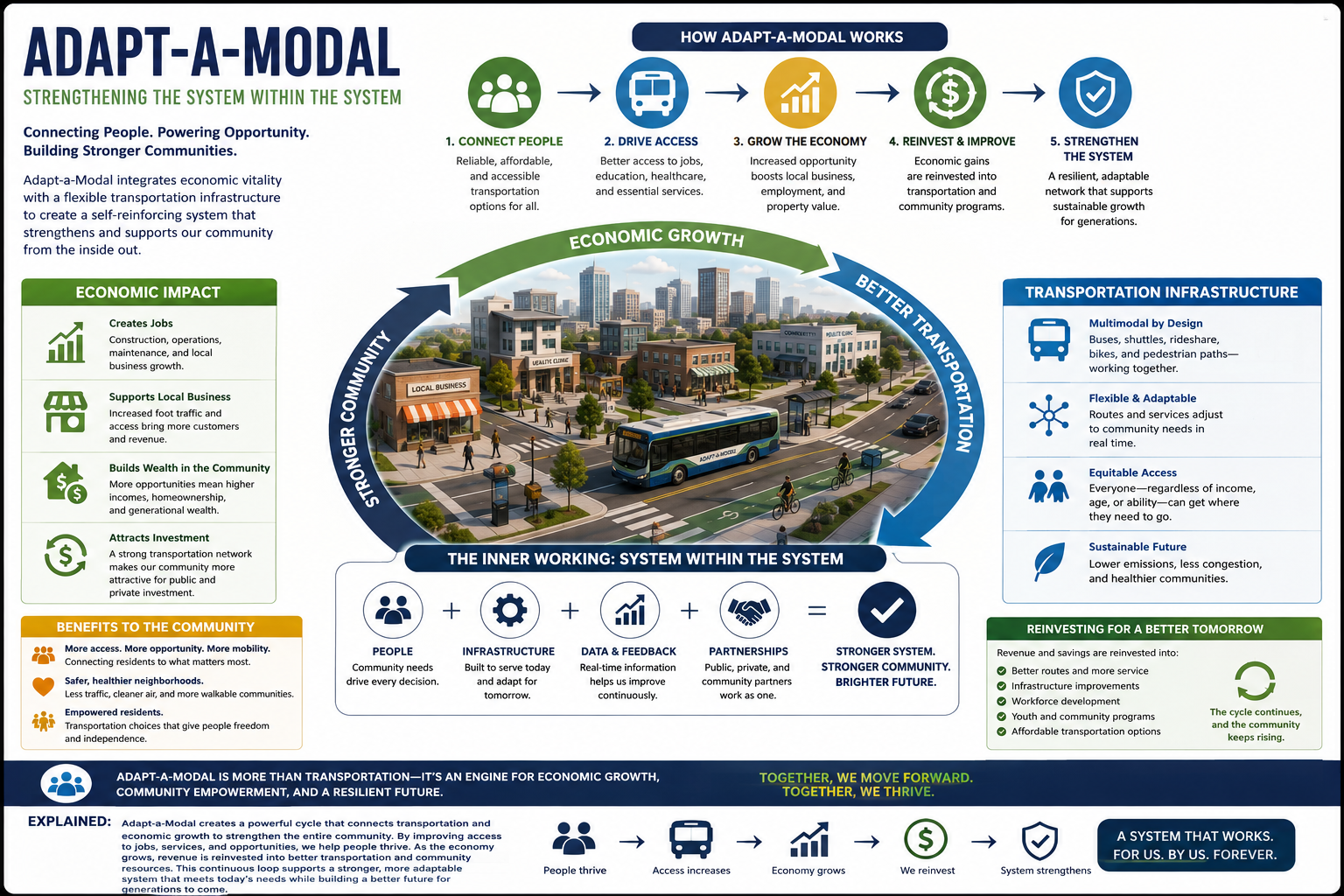
Easy-to-Understand Economic Plan
This plan belongs after the elevated-rail benefits section because it translates the Adapt-a-Modal concept into a simple public story: connect people, improve access, grow the local economy, reinvest the gains, and strengthen the system over time.
Reliable transportation helps residents reach jobs, services, education, healthcare, and daily needs.
Better access can support small businesses, employment, property value, and community wealth.
Economic gains can be directed back into service, infrastructure, workforce development, and community programs.
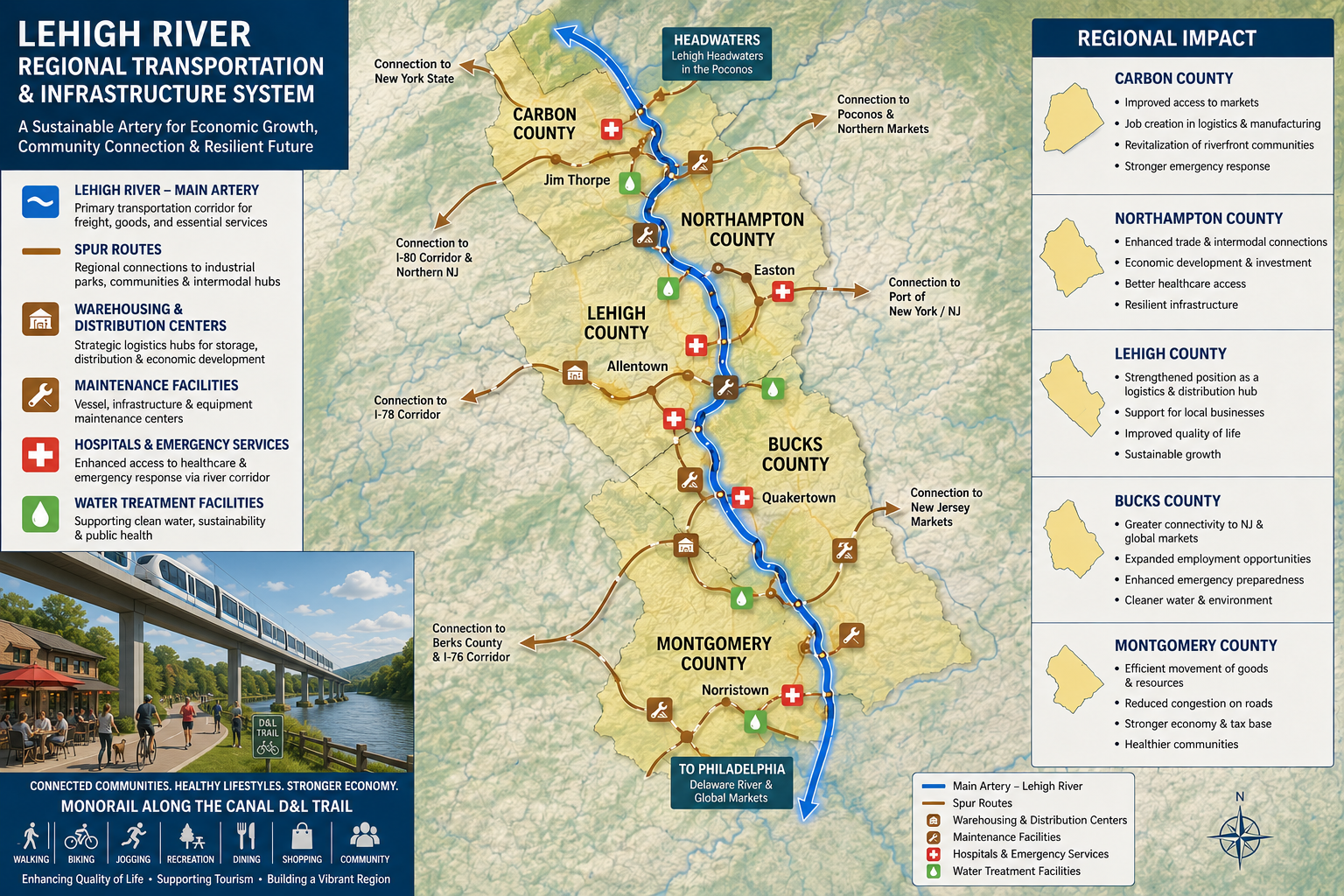
Regional System Map
A regional view of the Adapt-a-Modal network — the Lehigh River main artery and its spur routes linking warehousing and distribution centers, hospitals and emergency services, maintenance facilities, and water treatment across Carbon, Northampton, Lehigh, Bucks, and Montgomery counties, with a monorail running alongside the D&L Trail.
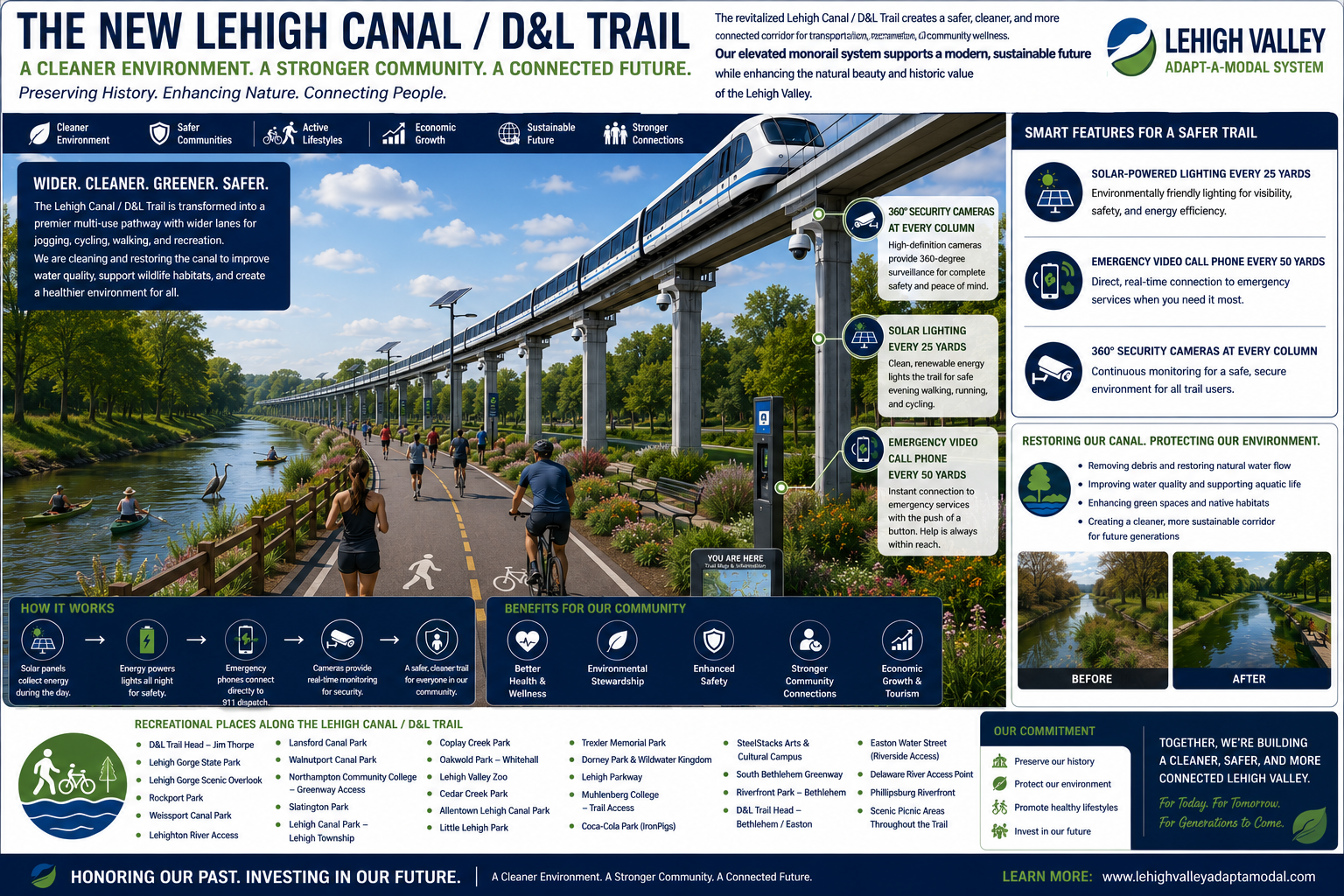
Canal & Trail Integration
This rendering shows the Adapt-a-Modal corridor as a shared civic landscape: the canal remains a visible historic and recreational feature, the D&L Trail keeps its ground-level pedestrian and cycling role, and the elevated guideway runs above the corridor to add regional mobility without taking over the trail experience.
Maximizing Regional Resource Potential
Adapt-a-Modal turns the Lehigh Valley's existing assets into a single connected system. By linking Lehigh Valley International Airport and Queen City Municipal Airport through an elevated monorail station, the network lets air travel, ground transportation, emergency medical care, and regional logistics share one piece of infrastructure — putting resources the region already owns to their fullest use.
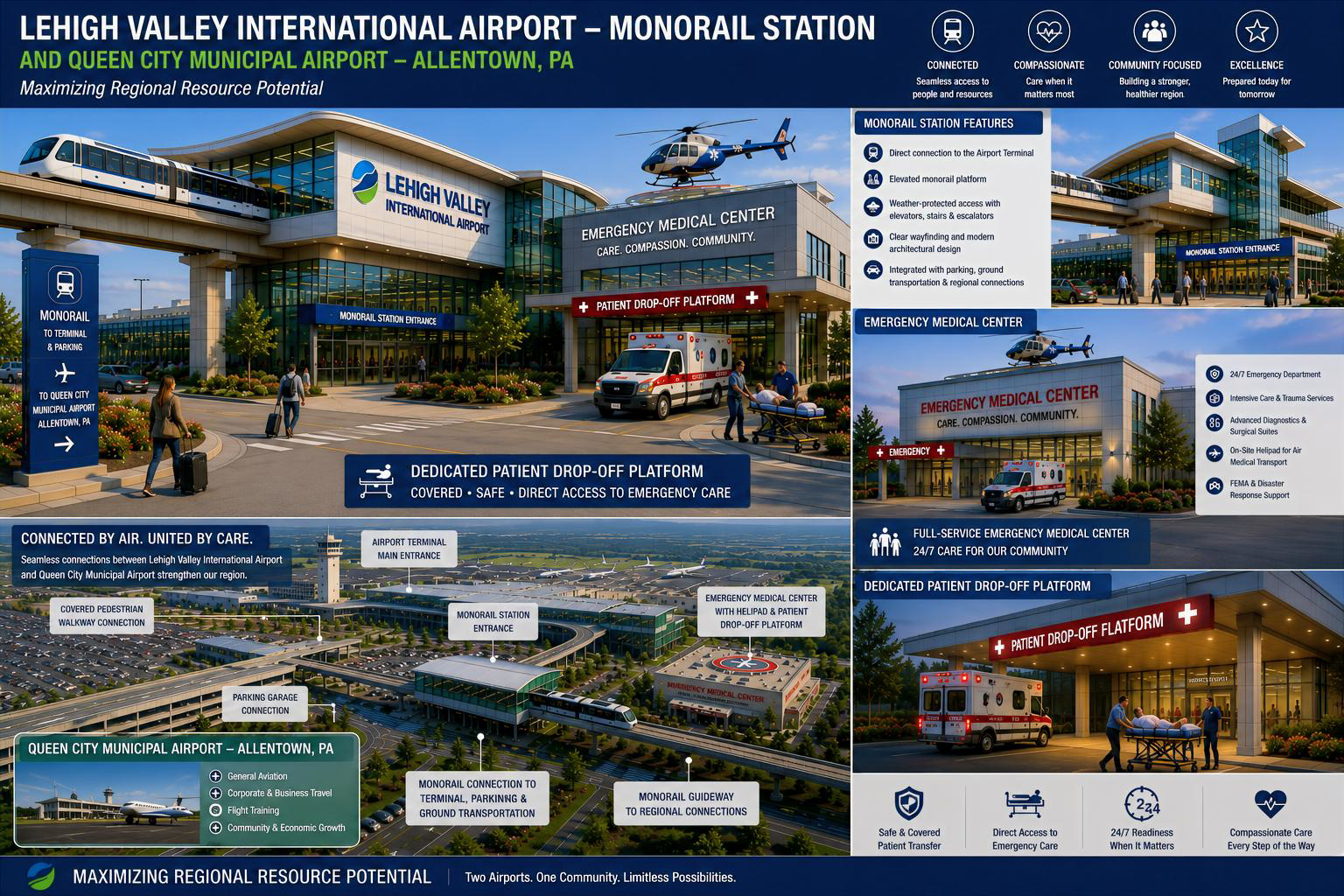
A monorail spur ties Lehigh Valley International Airport to Queen City Municipal Airport, strengthening both with shared passenger and freight access instead of duplicated infrastructure.
An integrated full-service emergency medical center with rooftop helipad and a dedicated, covered patient drop-off platform places 24/7 care directly on the network.
Air travel, ground transportation, medical logistics, and regional development all draw on one connected hub — maximizing what the Lehigh Valley already has.
National Interest & Partnership
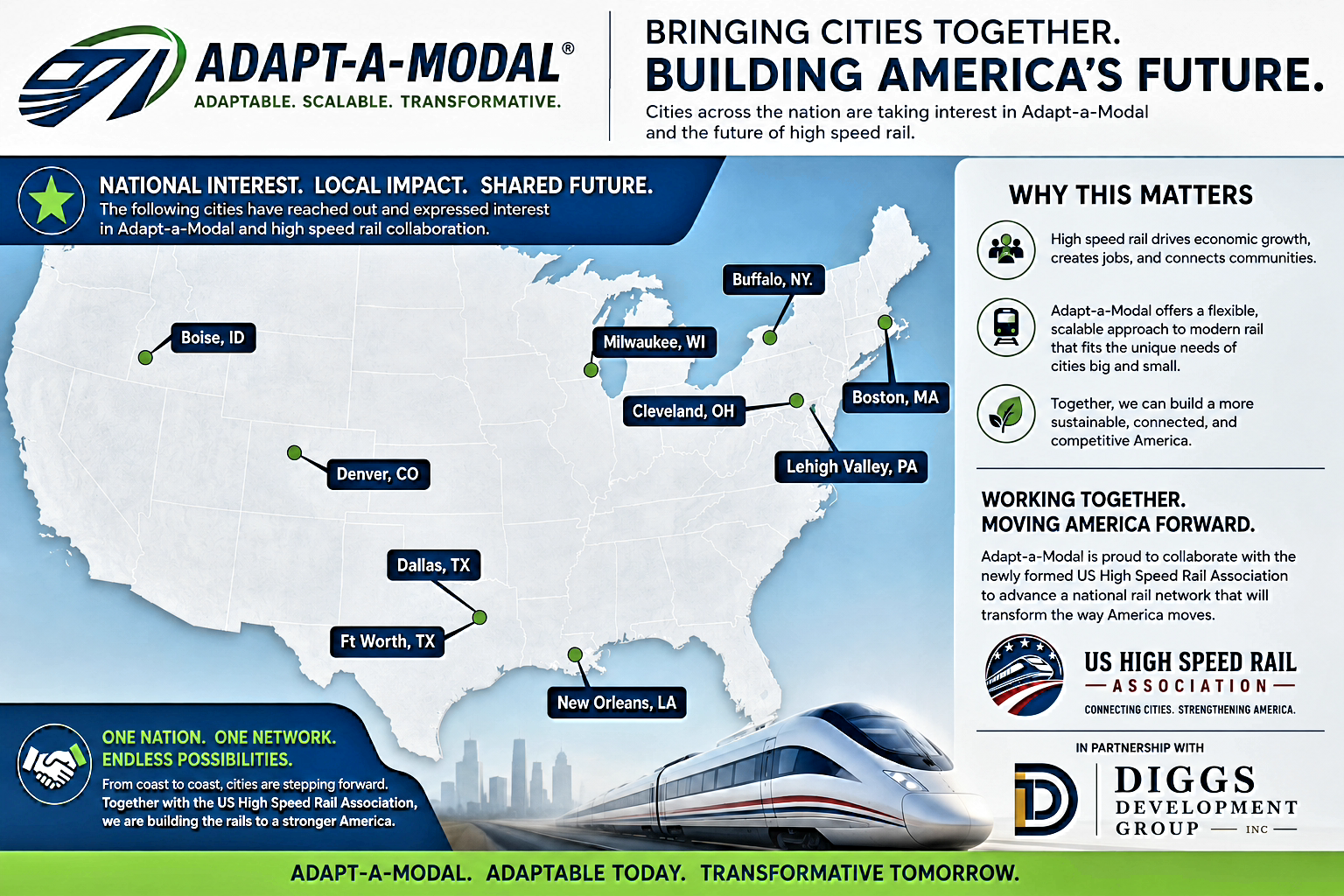
Cities across the nation are taking interest in Adapt-a-Modal and the future of high speed rail — and DDG is proud to collaborate with the newly formed US High Speed Rail Association to advance a national rail network.
Infrastructure Planning
The Adapt-a-Modal network is built on a tiered substation model. Each type scales its footprint, services, and connections to match the community it serves — from full regional hubs to lightweight local stops.
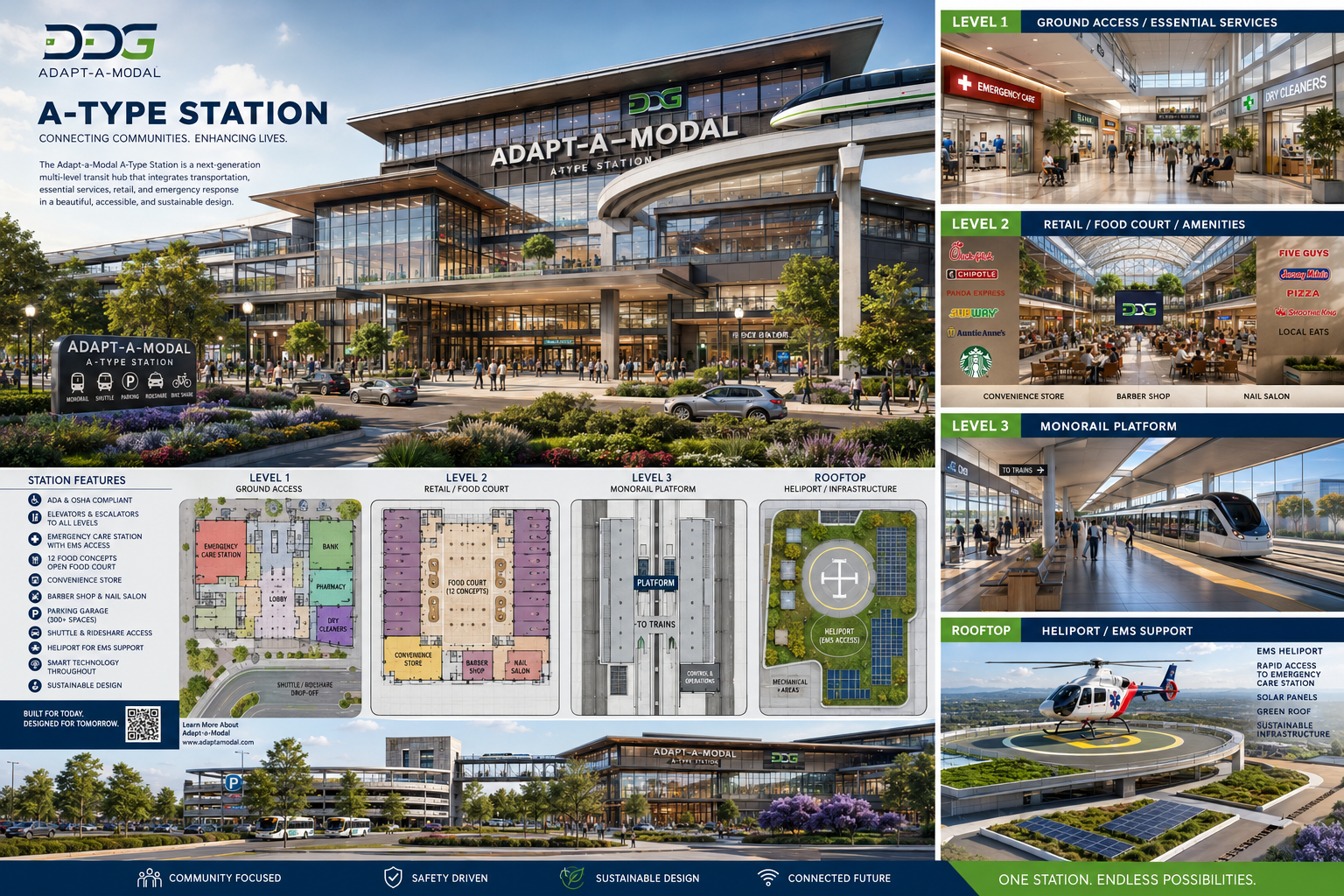 Type A
Full-service anchor stations that combine passenger transfer with commercial, civic, and emergency-support functions.
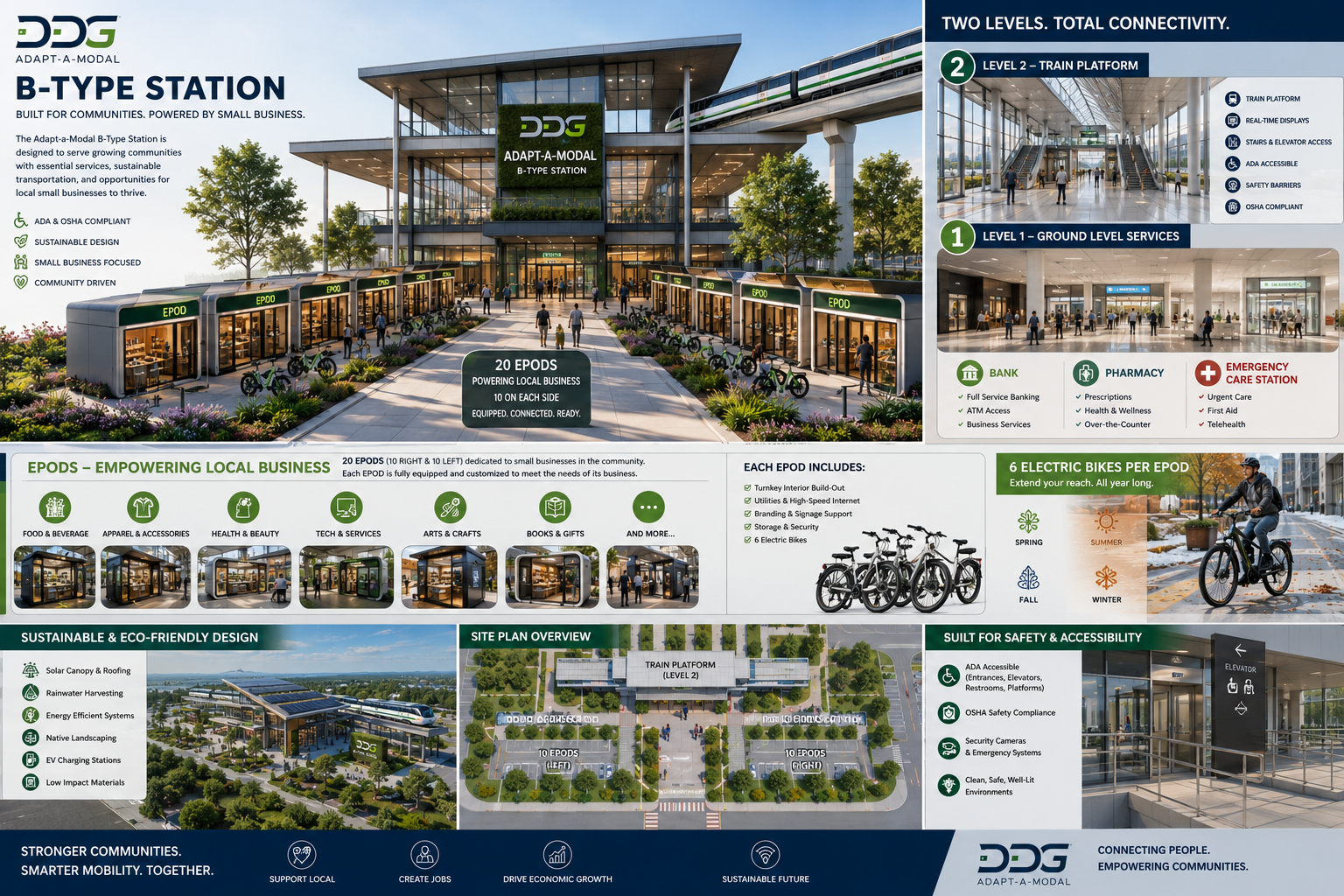 Type B
Mid-tier stations that serve neighborhoods and business districts with everyday access and freight handling.
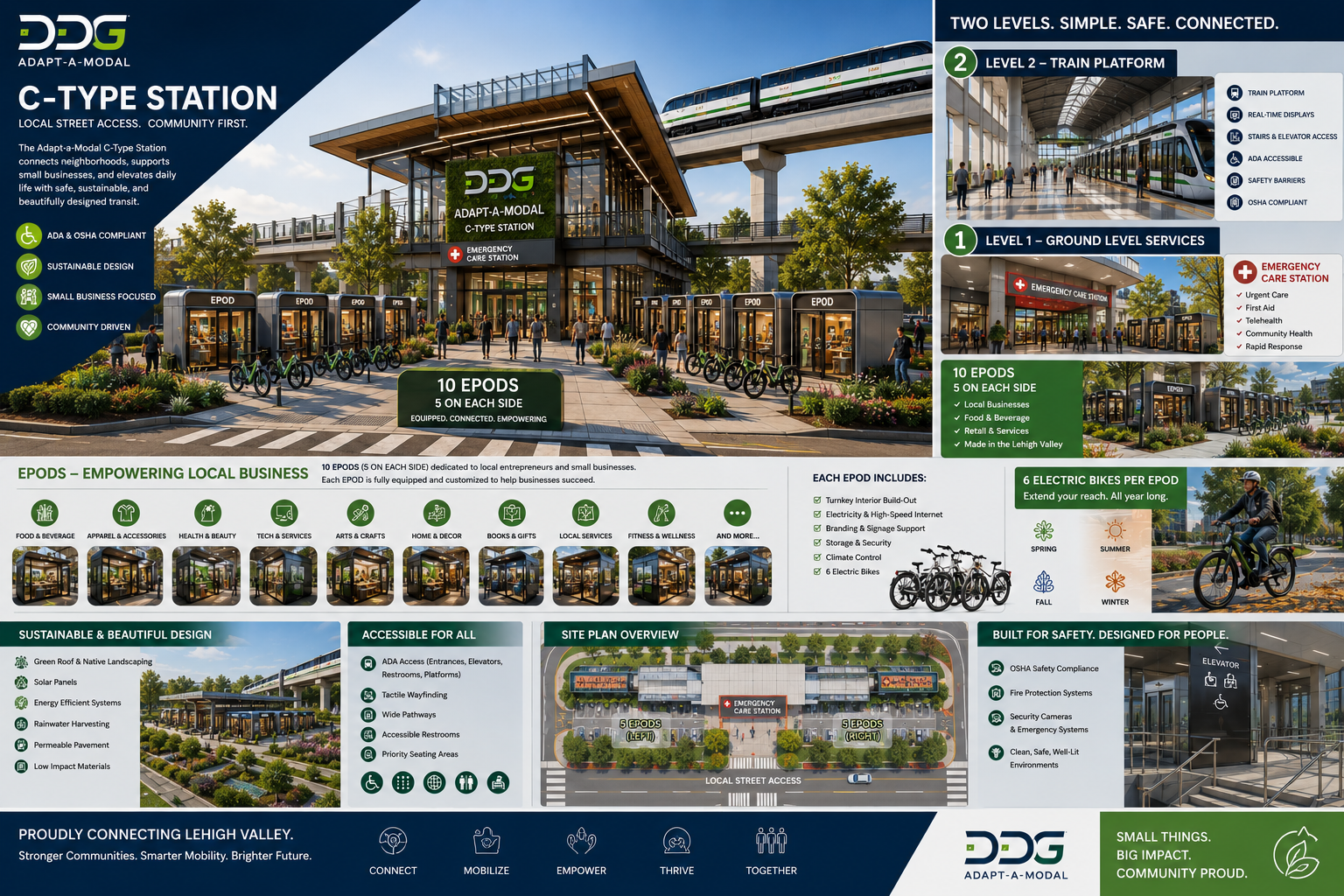 Type C
Streamlined, quick-to-deploy stops that extend network reach and complete first- and last-mile journeys.
Services
Concept design, corridor planning, station strategy, and public-facing explanation materials.
Monorail, light rail, specialized vehicle systems, passenger access, and logistics support planning.
Corporate offices, maintenance yards, station amenities, retail integration, and development programming.
Professional presentations, sponsorship packages, investor letters, charts, renderings, and event concepts.
Insights
Perspective on regional mobility, infrastructure, and the future of the Lehigh Valley — published here so you can read it directly, no login required.
Featured Direction
DDG is positioned to present a forward-looking system that can serve passengers, businesses, hospitals, emergency services, freight users, and regional destinations.
Discuss the ProjectProject Portal
So the answers now live in one place. The project portal states what Adapt-a-Modal is, why it matters, and exactly what DDG is asking for — with the briefing material behind every claim, open to read.
Contact
Send us a message and we'll get back to you. Submissions are delivered straight to our inbox.
Prefer email? Reach us directly at info@diggsdevelopmentgroup.com.

Industry Recognition